
The Slow Decay of Google
Simple Beginnings
I was always an Altavista man, myself. While everyone else was throwing their search queries into the likes of Yahoo! and Excite, I’d found web search nirvana in the view from above. Sure, I told who’d ever listen that Altavista was the better search tool, but the marketing dollars being spent on AskJeeves and Lycos meant that my claims were silenced by flashy ads and stadium billboards. But then my friend showed me this new search engine on her family’s boxy white PC. This was probably in late 1999 or early 2000. It was simple, uncluttered, and it just worked. It had a strange name, but then again, every dot-com company back then had a strange name.
It was Google, and from that date forward, I never went back to Altavista.
And Google was, in fact, amazing. They seemed to do everything right. Their products were innovative, their credo of “do no harm” was admirable, and they pushed the internet forward in ways most of us didn’t think possible without Sergey Brin and Larry Page, Google’s co-founders. Sure, they had some product stumbles along the way (Google+, Google Wave, Google Glass, et al.), but those that did succeed - and there were many - seemed to make the world a better place.
When Gmail launched in 2004, it offered a gigabyte of free storage at a time when competing email services were measuring their offerings in megabytes. Google Maps arrived in 2005 and changed how we navigated the world. Street View followed in 2007, giving us the slightly miraculous ability to virtually stand on a street halfway around the planet. Google Earth made geography endlessly fascinating, and Google Translate helped remove linguistic barriers that had existed for centuries.
These weren't simply better versions of existing products. They made previously complicated things feel effortless. Even when Google didn't invent the underlying technology, it had an extraordinary ability to make it accessible, intuitive, and useful.
The way they made money was incredible, too. AdWords and AdSense were relatively unobtrusive elements that took digital advertising by storm. And with their purchase of DoubleClick in 2008, Google solidified itself as the best digital advertising platform available.
They bought YouTube and Motorola’s mobile division. They grabbed DocVerse (soon rebranded as Google Docs), Zagat, Waze, and Nest, among many, many other acquisitions. And all the while, they said, “use our products for free,” but just know we may occasionally serve you an ad or two to help fund it. This tacit agreement was mutually beneficial for everyone involved. The users got products for free, and Google made boatloads of cash.
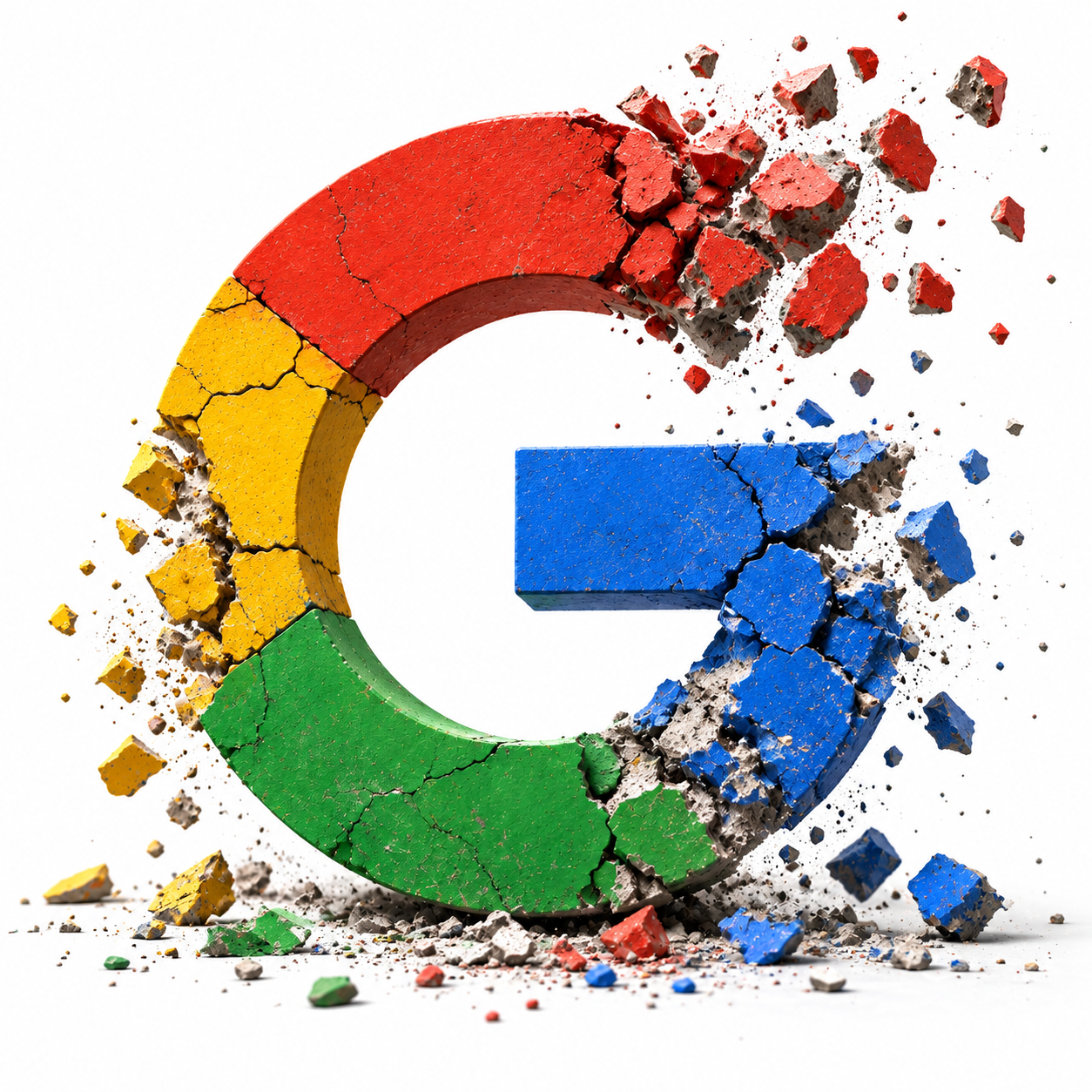
But then, and I’m sure you knew there was a “but then” coming based on the title of this article and the accompanying graphic, something shifted.
The Beginning of the End/The End of the Beginning
What has Google introduced lately that inspires that same sense of wonder?
There's Gemini, Google's answer to the generative AI revolution, which feels at least partly like an enormous corporation responding to the uncomfortable realization that someone else had captured the public imagination. There's AI Overviews, which answers questions directly within search results, sometimes replacing the pleasant experience of exploring the internet with the slightly less pleasant experience of having the internet summarized for you. And there's the seemingly endless procession of Pixel phones, each promising increasingly sophisticated ways to improve photographs that, frankly, already looked pretty good.
To be fair, Google is still doing genuinely impressive work. NotebookLM is clever and useful. DeepMind's scientific advances, including AlphaFold, are extraordinary. Its Veo video-generation models are impressive, and Alphabet's Waymo has made autonomous driving a reality in ways that seemed impossible not long ago. Pretending Google isn't innovating at all would be unfair.
But I think there's a difference between technological achievement and creating something people fall in love with. Google's research departments can still astonish us. Its everyday consumer products increasingly seem designed by committees tasked with protecting market share and extracting additional revenue.
The company that once seemed determined to invent the future now often seems content to monetize the present.
Playing in Politics
Then there's the political transformation, which I find considerably harder to forgive.
In January 2025, Google joined other technology companies in donating $1 million to Donald Trump's inauguration fund. CEO Sundar Pichai attended the inauguration, joining a procession of Silicon Valley executives suddenly eager to establish friendly relationships with an administration whose policies many in their industry had previously criticized.
A month later, Google announced it was abandoning its diversity-based hiring targets and reviewing other diversity, equity, and inclusion initiatives. The company cited a changing legal and policy environment, but the timing was difficult to ignore.
Then came the maps.
On February 10, 2025, Google began displaying the Gulf of Mexico as the Gulf of America for users in the United States, following Trump's executive order and the subsequent update to the federal geographic names database. Google explained that it was following its longstanding policy of reflecting official government naming conventions. In Mexico, users would continue to see Gulf of Mexico, while users elsewhere would see both names.
Which is an interesting approach to geography, where the name of a body of water depends on which side of a political border you're standing.
I understand Google's explanation. A mapping service needs consistent standards, and using official geographic databases is defensible. But this was also a moment when a company with tremendous influence over how billions of people understand the world could have acknowledged the difference between an internationally established geographic name and a unilateral political rebranding.
Instead, Google complied.
And in September 2025, YouTube agreed to pay $24.5 million to settle a lawsuit Trump brought after the platform suspended his ability to upload videos following January 6, 2021. Of that settlement, $22 million was designated for the Trust for the National Mall, toward a proposed White House ballroom. YouTube admitted no wrongdoing and was not required to change its policies.
I'm not suggesting these decisions were illegal, nor that maintaining working relationships with elected governments is inherently wrong. But taken together, they paint an unflattering picture of a company that once celebrated independence and unconventional thinking, now carefully managing its proximity to political power.
It's difficult to imagine the early Google, the company that proudly told the world not to be evil, being particularly enthusiastic about all this.
How I Learned to Stop Watching and Learned to Love the Ad
If the political decisions show how Google's priorities have changed at the corporate level, YouTube shows what those priorities feel like in your hands.
And good Lord, has YouTube become annoying.
I understand advertising. I've spent much of my professional life working in advertising. I believe in its power, its creativity, and its ability to make enormous amounts of content available to people who otherwise couldn't afford it. I also understand that creators deserve to be paid for their work. None of that is in dispute.
But there is a difference between advertising that supports an experience and advertising that actively destroys it.
YouTube seems increasingly incapable of telling the difference.
Try watching a video on your phone. Before it begins, you may have to sit through one advertisement, sometimes two. When the actual video finally starts, you're already several taps and a small negotiation away from what you originally wanted to watch. Then, just as you become interested in the content, another advertisement interrupts it.
And increasingly, the interruptions aren't confined to traditional commercials.
On mobile devices, advertisements can appear directly over the content you're trying to watch. I've encountered enormous promotional panels that occupy an absurd proportion of the screen while the video continues playing behind them. Other advertisements settle into corners of the video, refusing to leave until you locate a tiny dismissal button and manually remove them.
Sometimes even that doesn't work.
This isn't merely my imagination. In March 2026, Android Authority reported complaints from YouTube users on both iOS and Android about advertising banners that persisted during fullscreen playback, sometimes even after users tapped the dismissal button. Some reported waiting approximately 30 seconds for the ads to disappear, while others had to exit the video entirely. The behavior may have been a software bug rather than an intentional feature, but the viewer experience was the same.
In November 2025, Search Engine Land also reported that YouTube had removed the close button from certain mobile advertising sidebars, keeping additional promotional content visible during horizontal video advertisements.
Think about the absurdity of that for a moment. We're watching videos on devices with screens roughly six inches tall, and Google has decided that some portion of those six inches should belong to an advertisement we have already seen, even while the content continues playing.
At what point does the commercial stop supporting the program and become the program?
It reminds me of watching television with someone who repeatedly stands directly in front of the screen to tell you about a product they think you might like. Except in this case, the person refuses to move until you tap them in exactly the right place.
And YouTube isn't simply tolerating a more aggressive advertising environment. It has continued developing systems designed to maximize advertising opportunities. In 2025, the company expanded the use of automatic mid-roll ad placements on qualifying videos, saying it was working to place interruptions at more natural breaks. YouTube says that not every available ad slot necessarily results in an advertisement, and that its systems attempt to balance viewer experience with revenue.
I'm sure they do. But as someone who actually watches the videos, I have some questions about how heavily that balance favors the latter.
There's also a peculiar psychological effect to all of this. Every advertisement creates an additional decision. Do I wait? Skip? Dismiss? Expand? Find the tiny X? Close the panel? Restart the video?
What ought to be a passive, enjoyable experience becomes a succession of small administrative tasks.
I don't want to manage advertising. I want to watch the video.
And for anyone tempted to suggest that I simply pay for YouTube Premium, I'd point out that this seems to be part of the problem. In April 2026, YouTube increased the standard individual Premium subscription price in the United States from $13.99 to $15.99 per month. Its less comprehensive Premium Lite subscription rose from $7.99 to $8.99.
In other words, Google has developed an increasingly unpleasant free experience and now offers to make some of that unpleasantness disappear for an additional monthly fee.
That's certainly one way to build a business. But it’s a far less compelling philosophy of innovation.
Perhaps the most frustrating thing about Google's transformation is that, financially speaking, it has been enormously successful.
It’s Money in the Bank
According to Alphabet's 2025 annual report, the company generated approximately $402.8 billion in total revenue, including $294.7 billion from advertising. YouTube advertising alone generated $40.4 billion, up from $36.1 billion the previous year.
Those aren't the numbers of a company in financial decline. They're the numbers of a company that has discovered an extraordinarily profitable way to monetize our attention.
But those figures also raise an obvious question: With $40 billion in annual YouTube advertising revenue, how much more intrusive does the experience really need to become?
Could the company survive without an advertisement floating over someone's video? Could it perhaps give users a little more control over their screens? Might a business with hundreds of billions in annual revenue occasionally decide that the best way to improve a product is simply to leave people alone?
This isn't a complaint about advertising itself. It's a complaint about a company that seems to have forgotten advertising works best when the audience doesn't despise the environment in which it appears.
And Google's problems extend beyond irritating its customers. In August 2024, a federal judge ruled that Google had illegally maintained a monopoly in online search. In April 2025, another federal court found that it had monopolized portions of the online advertising technology market.
In September 2026, that second court ordered changes to Google's advertising practices and required antitrust compliance oversight, although it stopped short of forcing a breakup. Google disputes part of the ruling and plans to appeal.
There's something almost poetic about a company whose original mission was to organize the world's information becoming the subject of multiple major antitrust rulings over its control of how that information is found, distributed, and monetized.
Google hasn't run out of money, engineers, or technological ambition.
It may, however, be running out of goodwill.
Evil Approaches
Google's original corporate motto, "Don't be evil," was one of Silicon Valley's most recognizable expressions of idealism. It was a wonderfully simple idea, almost childishly optimistic, suggesting that a technology company could become enormously successful without abandoning its responsibility to the people who relied upon it.
Over time, the phrase faded. When Alphabet was established in 2015, its corporate code adopted the more conventional instruction to "do the right thing." In 2018, Google removed "Don't be evil" from the preface of its own code of conduct, although it retained the phrase at the end.
Perhaps that was inevitable. Companies grow, priorities change, shareholders demand returns, and idealism tends to become more negotiable when several hundred billion dollars are at stake.
But what I find most disappointing isn't simply that Google has become more corporate. It's that Google has become less considerate.
The original Google seemed to approach technology with a fundamental question: How can we make this easier, faster, more useful, or more enjoyable for people?
Today's Google too often seems to ask a different question: How much can we extract from this experience before people finally get fed up?
And because Google's products are so deeply embedded in our lives, most of us simply endure it. We keep searching, keep checking Gmail, keep opening Maps, and keep swatting away advertisements on YouTube. We complain, dismiss another promotional banner, and continue using the services because the alternatives aren't always particularly appealing.
That's the real danger of becoming indispensable. Eventually, a company can confuse our dependence with our affection.
I don't think Google is doomed. Far from it. Extraordinary people are still doing extraordinary work inside that company, and I'd genuinely love to see it rediscover some of the curiosity and restraint that once made it special.
But a company's downfall doesn't necessarily begin with collapsing revenue or disappearing customers. Sometimes it begins when people stop being excited about what it might create next and start wondering what new inconvenience it's going to impose upon them.
Google once promised us an internet that felt almost magical.
Now I just want to watch a video without having to close three advertisements.
Maybe it's time they adopted a new corporate motto. One that can drive them into the next phase of their business: Don't be annoying.
Notes & Sources
Google's Recent Innovation: Google, “Google's Year in Review: 8 Areas With Research Breakthroughs in 2025,” December 23, 2025. An overview of developments including Gemini, NotebookLM, Veo, and Google DeepMind.
Discontinued Google Products: Google, “Powering Down Google Reader,” March 13, 2013; Google, “A Message About Stadia and Our Long-Term Streaming Strategy,” September 29, 2022; Google, “Glass Enterprise Edition Announcement FAQ,” March 15, 2023.
Google's Support for Trump's Inauguration: The Guardian, “Google and Microsoft Donate $1m Each to Trump's Inaugural Fund,” January 9, 2025; Reuters, “Trump's Inauguration Billionaires, CEOs: Ambani, Zuckerberg, Bezos Attend Church, Ceremony,” January 20, 2025.
Google's DEI Policy Changes: Reuters, “Google Scraps Diversity-Based Hiring Targets,” February 5, 2025.
Renaming the Gulf of Mexico: Google, “Gulf of America Name Change in the U.S. — What You'll See in Maps,” February 10, 2025. Google's official explanation of its decision to display different geographic names depending on the user's location.
YouTube's Settlement With Donald Trump: Reuters, “YouTube to Pay $24.5 Million to Settle Trump Account Suspension Suit,” September 29, 2025.
Persistent YouTube Mobile Advertisements: Android Authority, “YouTube's Newest Ad Annoyance Is Testing the Patience of Mobile Viewers,” March 4, 2026. Reporting on fullscreen mobile advertising overlays that some viewers found difficult or impossible to dismiss.
YouTube's Non-Dismissable Ad Panels: Search Engine Land, “YouTube Locks Sidebar on Mobile Ads, Removing Close Option,” November 4, 2025.
Expansion of YouTube Mid-Roll Advertising: YouTube, “Clarifying the New Mid-Roll Ads Features & How It Relates to Ad System Updates in May,” March 13, 2025. An official explanation of automatic advertising placements and changes to mid-roll advertising.
YouTube Premium Subscription Increases: TechCrunch, “YouTube Premium and YouTube Music Are Getting More Expensive,” April 10, 2026.
Alphabet's Advertising Revenue: Alphabet Inc., “2025 Annual Report, Form 10-K,” filed 2026. The company reported $402.8 billion in total annual revenue, including $294.7 billion from Google advertising and $40.4 billion from YouTube advertising.
Federal Antitrust Rulings Against Google: U.S. Department of Justice, “Department of Justice Wins Significant Remedies Against Google,” September 2, 2025; U.S. Department of Justice, “Department of Justice Again Wins Substantial Relief Against Google,” September 16, 2026. These announcements address the federal search and advertising technology antitrust cases.
The Evolution of Google's Corporate Motto: 9to5Google, “‘Don't Be Evil’ Removed From Google's Code of Conduct, Except One Line,” May 18, 2018.