The ALEX Project
Archive of Living Experience
There is a place on Earth where humanity quietly whispers to the future. It isn't a capital city. It isn't a cathedral. It isn't the headquarters of the world's largest technology company.
It's a mountain.
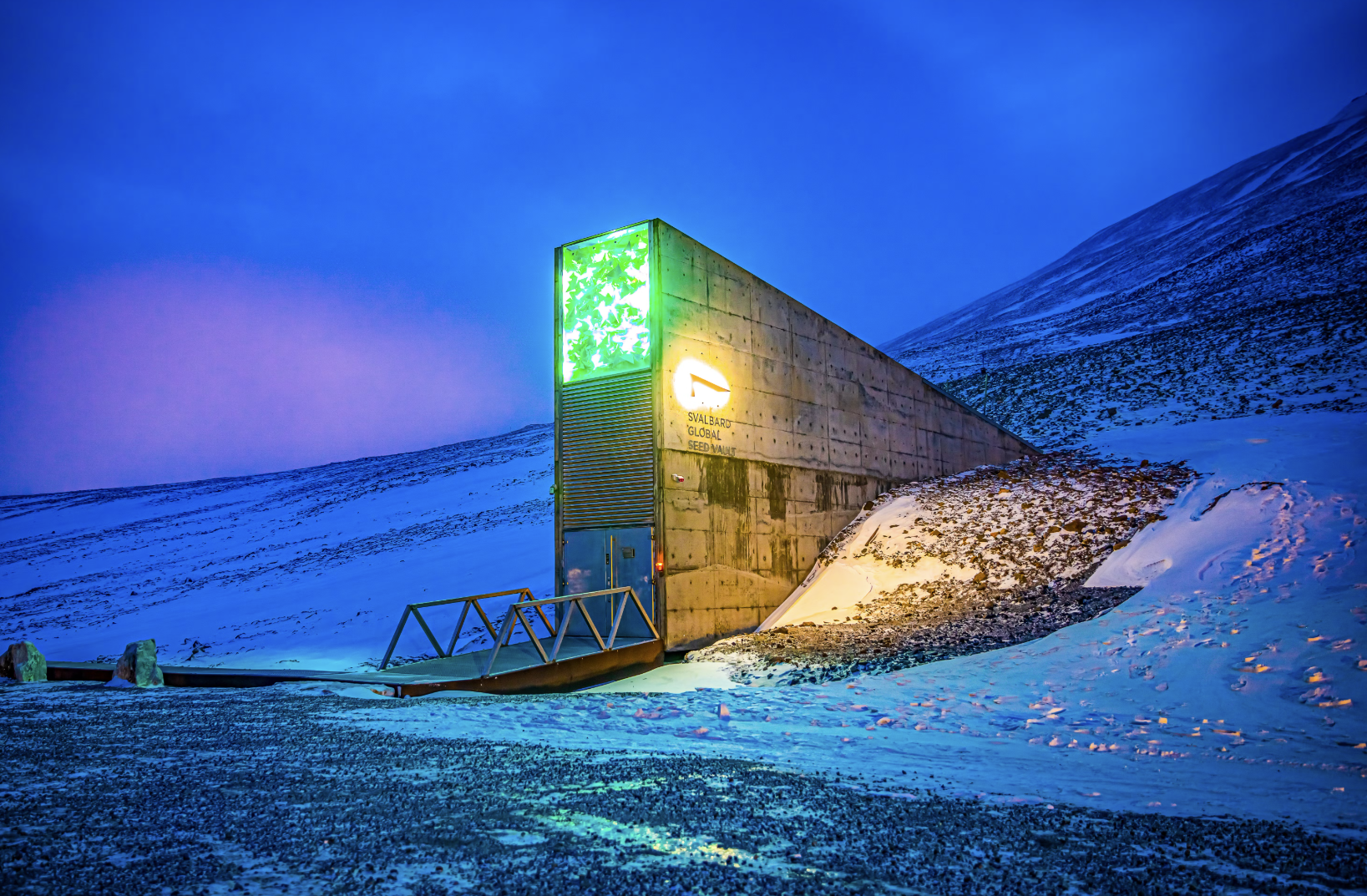
Far beyond mainland Norway, where the Arctic Ocean swallows the horizon and the seasons themselves seem to lose their meaning, lies the Svalbard archipelago. For months, the sun never rises above the horizon. Then, as if making amends, it refuses to set. The landscape is almost prehistoric. Jagged black mountains push through blankets of snow and ice. Polar bears roam where roads simply end. The wind has spent millennia carving the rock into something that feels less like geography and more like memory itself.
If you didn't know what was hidden there, you would drive right past it.
Emerging from the frozen mountainside is a simple concrete wedge, angular and understated, almost monolithic in its restraint. There are no grand columns. No towering glass façade. No attempt to impress. The most important things humanity builds rarely need to announce themselves.
Behind that quiet entrance, more than 400 feet inside the mountain, steel doors give way to long tunnels carved through ancient sandstone and protected by the Arctic permafrost. The temperature remains a constant -18 degrees Celsius, cold enough that even if the power were to fail, the mountain itself would continue protecting what lies inside.
This is the Svalbard Global Seed Vault. Many people know it by another name. The Doomsday Vault. I've never liked that description. It suggests fear. It imagines apocalypse. It mistakes caution for pessimism. The people who built Svalbard were not preparing for the end of the world. They were making a promise to the next one.
Inside those chambers rest more than 1.4 million seed samples, representing thousands of crop species collected from nearly every corner of the planet. Rice from Asia. Wheat from Europe. Sorghum from Africa. Maize from the Americas. Tiny capsules of possibility, each one carrying generations of adaptation, resilience, and life itself. They are backup copies of the plants that have fed civilizations for thousands of years, preserved so that wars, floods, fires, political instability, disease, or simple human error can never erase them forever.
It is one of the most extraordinary acts of long-term thinking our species has ever attempted. Someone looked beyond election cycles. Beyond quarterly earnings. Beyond their own lifetime. They imagined a child who would not be born for centuries, standing in a world they could never see, facing challenges they could never imagine. And then they asked a remarkable question:
What can we do today that will help them tomorrow?
That question built a vault. Not for us. For people we will never meet.
I've always found that breathtaking.
Because buried beneath the Arctic ice isn't just a collection of seeds. It's evidence that humanity, despite all of our flaws, is still capable of believing in a future we will never personally experience. The Seed Vault isn't really about agriculture. It's about stewardship. It's about the quiet understanding that some things are simply too important to lose.
I've thought about that mountain more times than I can count. Not because I'm fascinated by seeds. Because I can't stop wondering what else deserves a vault. If we are willing to preserve the genetic memory of our crops...
What should we be preserving about ourselves?
The Pole Star
People often ask founders the same question.
"Where do you see your company in five years?"
It's a fair question.
Sometimes they'll ask about ten years. Every so often, someone will ask about twenty. Investors want to understand the roadmap. Customers want to know the vision. Employees want to know they're joining something with momentum. Founders learn to answer with confidence. We talk about growth, products, partnerships, revenue, new markets, hiring plans, and all the milestones that define a successful company.
Those things matter. They have to. A company that doesn't survive the next five years has little chance of changing the next fifty. But I've noticed something about myself. Whenever someone asks me where I think Reflekta is going, my mind drifts much farther than a pitch deck ever could.
I don't think about the next funding round. I don't think about quarterly growth. I don't even think about whether we'll be around ten years from now. I find myself wondering what Reflekta could become one hundred years from now. Or two hundred. Or five hundred.
Not because I expect to see it. I won't. None of us will. But I think every founder, if they're honest with themselves, secretly hopes to build something that outlives them. Not because of ego. Because there is something deeply human about creating a thing that continues serving people long after you're gone.
The greatest institutions in history were never built for the people who founded them. They were built for strangers. Someone planted the trees whose shade they would never sit beneath. Someone carved the stones of cathedrals they would never see completed. Someone established universities knowing the most important discoveries would be made by minds not yet born. Someone buried millions of seeds inside an Arctic mountain for generations they would never meet.
Great institutions are acts of generosity stretched across time. The older I get, the more I believe that's the highest calling of any company. Not simply to build products. Not simply to create wealth. Not simply to disrupt an industry. But to leave behind an institution that makes humanity itself a little stronger.
For a long time, I couldn't quite articulate what that institution looked like. I knew Reflekta was never really about artificial intelligence. AI is remarkable, but it is a tool. An engine. A means to an end.
The destination has always been something else. Something larger. Something that, until recently, felt almost impossible to describe. Then one day, somewhere between thinking about the Seed Vault, the Library of Alexandria, and the thousands of conversations we've helped families preserve through Reflekta, the idea crystallized.
It wasn't a product idea. It wasn't a feature request. It wasn't even a business strategy. It was a responsibility.
A responsibility to ask a question that I don't think we've ever seriously asked as a civilization. If humanity built a vault to preserve the future of our food... What would it look like to build one that preserved the future of ourselves?
That question has become my Pole Star. The fixed point on the horizon that I return to whenever I think about where Reflekta could go, not five years from now, but a century from now.
I call it ALEX.
The Archive of Living Experience.
I don't know if it will take twenty years to build. Or fifty. Or a hundred. I don't know if I'll see it finished. In many ways, I hope I don't. Because if ALEX is worthy of the idea behind it, it should never really be finished.
It should become one of those rare institutions that every generation quietly inherits from the one before it, adding its own voices, its own stories, its own wisdom, before passing it forward again. Not a monument to technology. A monument to humanity.
What We Choose to Remember
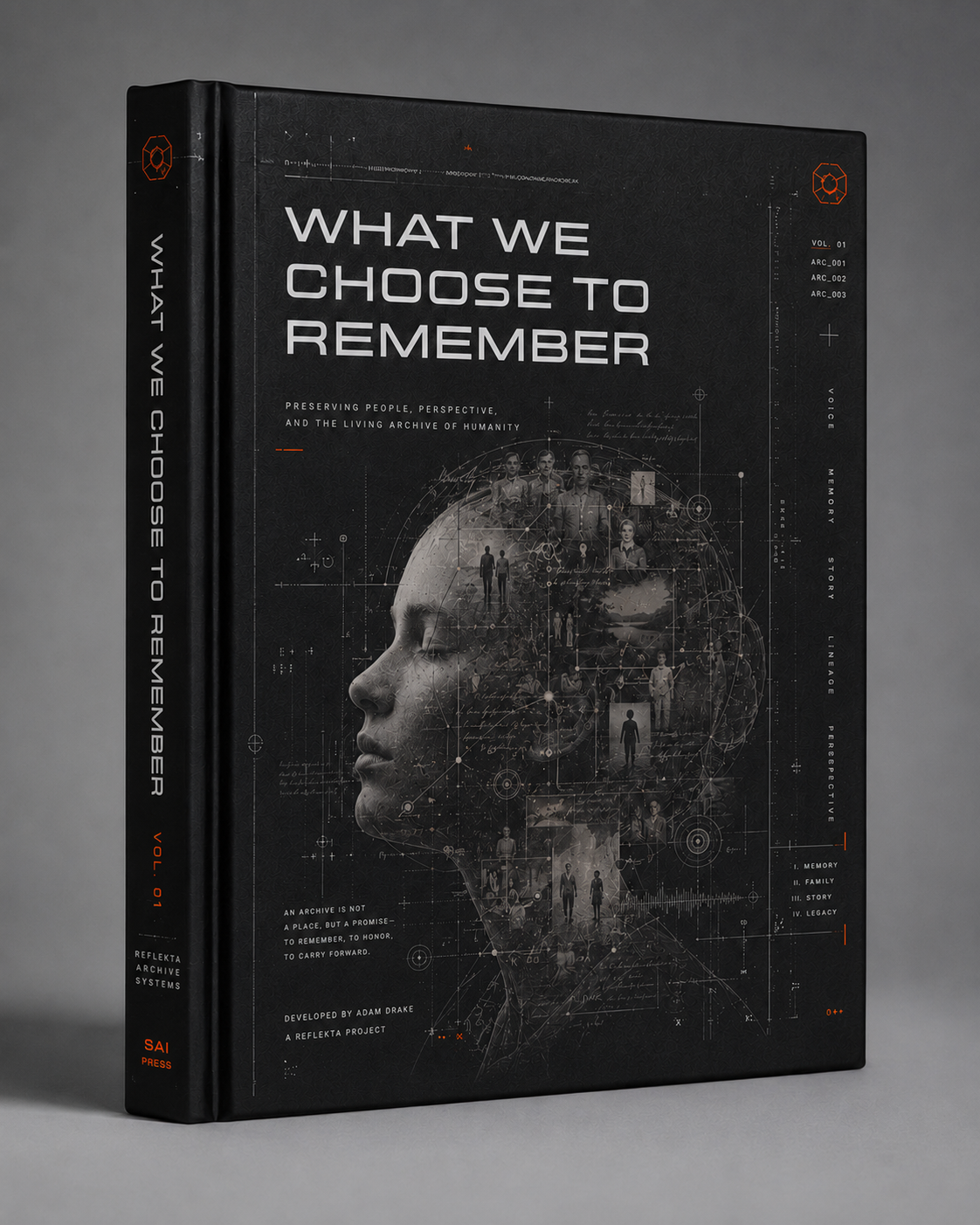
Humanity has become extraordinarily good at preserving information.
For thousands of years, civilization has been engaged in a remarkable act of remembrance. We carved stories into cave walls before we understood the written word. We pressed symbols into wet clay. We copied manuscripts by candlelight, knowing that a single volume might take years to complete. We built libraries that reached toward the heavens, museums to protect the objects of our past, archives to preserve the decisions of governments, observatories to record the movements of the stars, and vaults to safeguard everything from works of art to the genetic code of the plants that feed us.
Today, we preserve almost everything.
Our books are digitized. Our photographs are backed up in data centers scattered across continents. Our music, our films, our research, our maps, our medical records, our software, and even our DNA can be copied, duplicated, and protected against the passage of time. We have become remarkably sophisticated custodians of information.
And we should be proud of that.
Every generation inherits the knowledge of the generations that came before it because someone believed the future deserved access to the past. That belief is one of the defining characteristics of civilization itself. But the more I think about it, the more I wonder whether we've overlooked something fundamental. We've become exceptionally good at preserving information. We've become remarkably poor at preserving people. Not their bodies. Not their possessions. Not even the events of their lives. The people themselves. The way they thought. The stories they carried. The lessons they learned. The laughter that filled a room before anyone else understood the joke. The subtle wisdom that only comes from living through decades of triumph, disappointment, heartbreak, and hope.
History has always had a tendency to remember extraordinary people. Kings and queens. Presidents and generals. Inventors and explorers. Artists whose work changed the world. Their names fill our textbooks, museums, and documentaries. But civilization wasn't built by famous people. It was built by ordinary ones.
By teachers who inspired students they would never see become adults. By nurses who quietly comforted strangers through the hardest nights of their lives. By mechanics who kept entire communities moving. By immigrants who crossed oceans carrying little more than hope. By parents who sacrificed their own dreams so their children could pursue theirs. By grandparents who became the living memory of a family, preserving stories that had already survived generations before reaching them.
These people rarely appear in history books, and yet history would not exist without them.
Civilization is not the story of remarkable individuals. It is the accumulated story of billions of ordinary lives, each contributing something irreplaceable to the whole. That realization has stayed with me for years because every family eventually arrives at the same quiet moment.
It usually begins with a sentence that is almost universal.
"I wish I had asked them."
I wish I had asked my grandfather what it felt like to leave home for the first time.
I wish I had asked my mother where she learned that recipe.
I wish I had asked why our family always celebrated that holiday the way we did.
I wish I had recorded their laugh.
I wish I could remember the sound of their voice.
Those sentences are heartbreakingly common because they reveal something about the nature of memory itself.
For almost all of human history, every person carried within them an entire library that existed nowhere else. Their memories, their perspective, their humor, their regrets, their advice, their stories, the tiny observations that never made it into journals or photographs, all of it lived inside a single human mind. And when that person passed away, much of that library disappeared forever. We accepted this because we had no alternative. Loss was simply part of the human condition.
Every generation inherited photographs, heirlooms, and perhaps a few stories that had somehow survived around dinner tables. Everything else slowly faded into silence. But every so often, history changes because humanity invents a new way of remembering.
The printing press transformed the preservation of ideas. Photography transformed the preservation of moments. Motion pictures preserved movement. Audio recording preserved voices. The internet connected humanity's collective knowledge in ways previous generations could scarcely imagine.
Artificial intelligence may become the next chapter in that story. Not because it replaces human beings. Not because it imitates consciousness. But because, for the first time, it gives us the possibility of preserving something deeper than information. It gives us the opportunity to preserve perspective.
There is a profound difference between reading that your great-grandfather served in World War II and hearing him describe, in his own voice, what it felt like to watch the shoreline disappear behind the ship as he sailed toward an uncertain future. One tells you what happened. The other allows you to understand what it meant. That difference may be one of the most important opportunities our generation has ever been given. Because if we truly stand at the beginning of an era in which every human life can leave behind more than a name carved into a headstone or a box of fading photographs, then I believe we have inherited an extraordinary responsibility.
Not merely to preserve our information. But to preserve one another.
The Next Great Institution
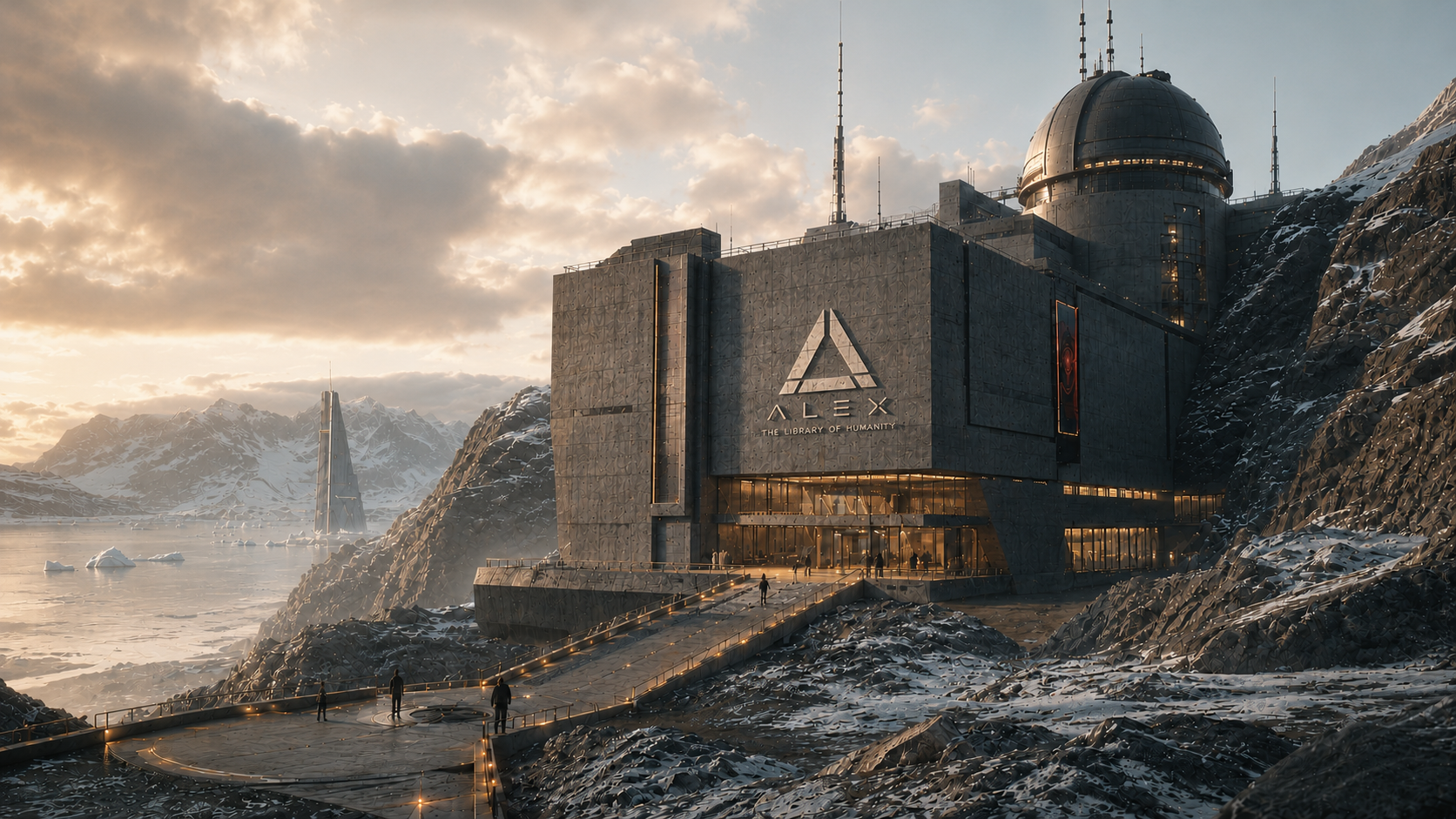
There is an interesting pattern that repeats itself throughout history. Every so often, humanity decides that something is too important to entrust to chance. So we build an institution around it.
We built libraries because knowledge deserved to survive kingdoms. We built museums because culture deserved to outlive generations. We built universities because wisdom should be cultivated, challenged, and passed forward. We established observatories because understanding the universe required patience measured not in years, but in centuries. We built archives because governments, laws, discoveries, and history needed permanence. And in the frozen mountains of Svalbard, we built a vault because the biological future of our species was too precious to lose.
These places have something remarkable in common. They were never really built for the people who commissioned them. They were built for strangers. For children not yet born. For researchers whose names would never be known. For civilizations that did not yet exist. Their founders understood something that seems increasingly rare today: that some investments are measured not by quarterly returns, but by the number of generations they continue to serve.
I often wonder what future historians will say about our own era.
Will they remember us primarily as the generation that built larger data centers, faster processors, and more capable artificial intelligence? Or will they remember us as the generation that finally asked a different question altogether?
Not how intelligent our machines could become. But how wisely we might use them.
Artificial intelligence has understandably captured the world's imagination. Every week seems to bring another breakthrough, another model, another announcement that pushes the boundaries of what computers can do. Much of that progress is extraordinary, and it should be celebrated. But every transformative technology eventually arrives at a crossroads. It reaches a point where the question is no longer, "What is possible?" The question becomes, "What is worthy?"
History is full of civilizations that mastered extraordinary technologies without always applying them toward extraordinary purposes. The technologies changed the world, but the intentions behind them determined whether that change ultimately served humanity.
That is why I don't think the most important conversation surrounding artificial intelligence is about replacing work, automating tasks, or even achieving artificial general intelligence. Those are fascinating questions, but they are not the ones that keep me awake at night.
The question I keep returning to is much simpler. What is the greatest gift this technology could leave behind? For me, the answer has slowly become impossible to ignore. It isn't another productivity tool. It isn't another recommendation algorithm. It isn't another chatbot. It is the possibility that, for the first time in history, we can preserve not just what humanity knows, but who humanity is.
That is a fundamentally different mission.
Knowledge explains the world. Experience teaches us how to live within it. Knowledge tells us that a war occurred. Experience tells us what it felt like to kiss your family goodbye before boarding the train. Knowledge tells us when a scientific discovery was made. Experience reveals the years of frustration, failure, doubt, and persistence that made the discovery possible. Knowledge can explain how a community was built. Experience reminds us that communities are built one relationship, one kindness, one conversation at a time.
The more I think about it, the more convinced I become that civilization has always depended upon these invisible inheritances. Every generation benefits from wisdom accumulated by the one before it, yet so much of that wisdom has always disappeared because it lived only in memory. We have accepted that loss as inevitable because, until now, there was very little we could do about it.
But what if it no longer has to be inevitable?
What if, centuries from now, humanity looked back on our generation not because we built increasingly intelligent machines, but because we had the foresight to build one of the world's first true institutions dedicated to preserving human experience itself?
That is the vision behind ALEX. Not another platform. Not another application. Not another destination on the internet competing for attention. An institution.An Archive of Living Experience.
A place where the voices, perspectives, and stories of ordinary people are preserved with the same seriousness that previous generations preserved books, works of art, scientific discoveries, and seeds. A place that grows not because it seeks scale for its own sake, but because every new life added to it makes humanity's collective understanding a little richer, a little more complete.
Perhaps that sounds impossibly ambitious. I hope it does.
The institutions we admire most today almost certainly sounded impossible when they were first imagined. The Library of Alexandria was once just an idea. So was Oxford. So was the Smithsonian. So was the Svalbard Global Seed Vault.
Every institution that eventually shaped civilization began as someone looking at the future and quietly saying, "This should exist." I can't help but believe that ALEX belongs on that list.
Not because it would be the greatest technological achievement of our generation. But because it could become one of the greatest human ones.
A Mountain That Remembers
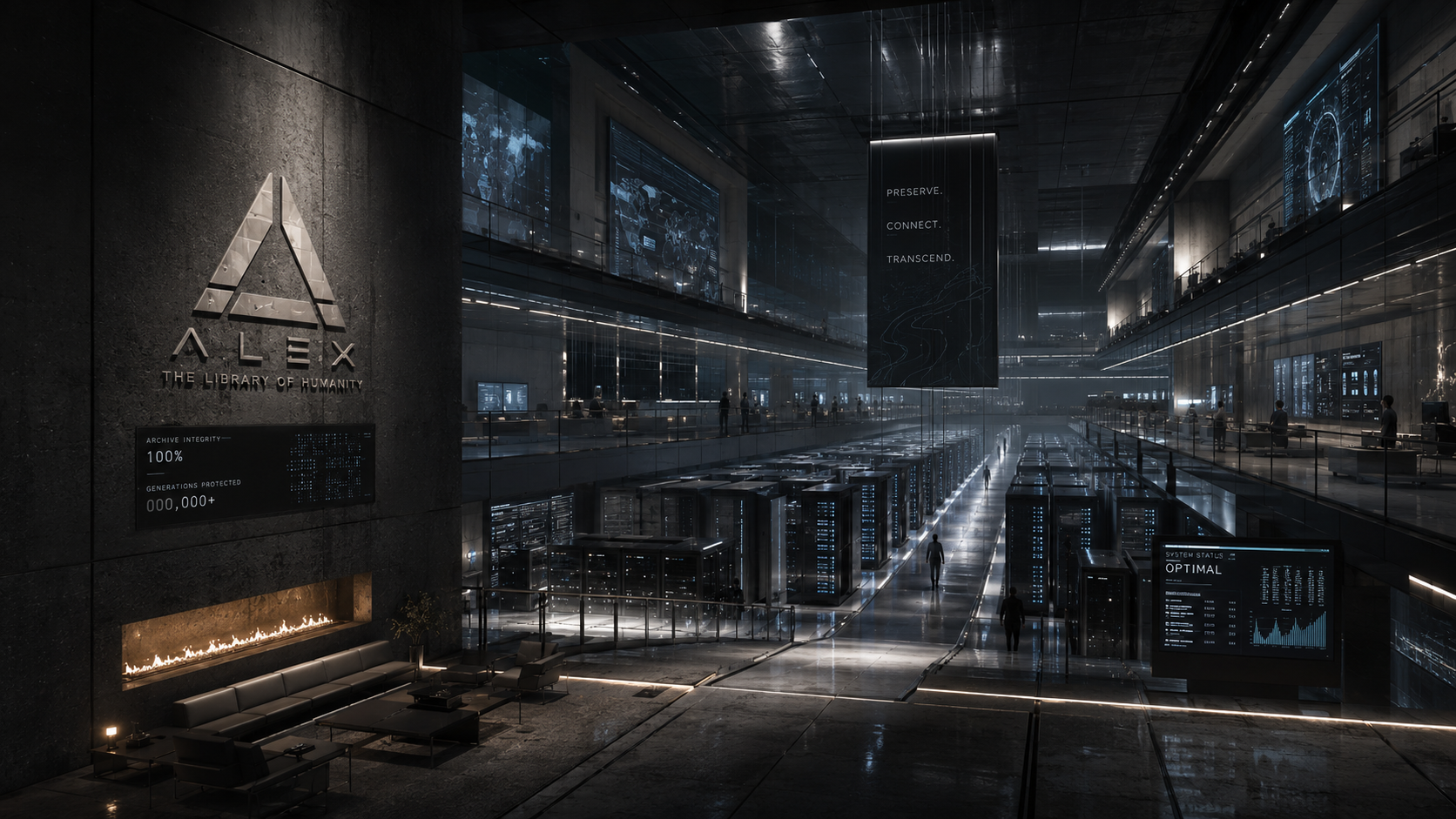
There’s a reason I keep returning to Svalbard.
It isn't because I think humanity needs another vault. It isn't because I find underground architecture particularly romantic. It is because, hidden inside that frozen mountain, is a philosophy that I believe extends far beyond agriculture.
The Seed Vault is remarkable not because of what it contains, but because of the assumptions it makes about the future.
It assumes that civilizations are fragile. That wars happen. That governments fall. That disasters, whether natural or man-made, can erase decades of progress in a matter of days. It assumes that redundancy is wisdom, not pessimism. Most importantly, it assumes that the people living centuries from now deserve the same opportunities we enjoy today, even if they never know the names of the people who protected those opportunities for them.
That way of thinking feels increasingly rare.
Our culture has become remarkably good at optimizing for the immediate. We measure success in quarters instead of generations, engagement instead of enrichment, virality instead of permanence. We celebrate what is new with extraordinary enthusiasm, while too often neglecting what will endure.
And yet, when history looks back at the civilizations that mattered most, it rarely remembers them for what they consumed.
It remembers them for what they preserved.
The Library of Alexandria sought to gather the written knowledge of the known world. Medieval monasteries became sanctuaries where manuscripts survived centuries of instability. Universities became living institutions because they understood that knowledge must not merely be accumulated, but continually renewed. Museums protected the physical artifacts of culture. Archives preserved the legal memory of nations. Svalbard safeguards the biological memory of our food supply. Each institution answered the same question in its own way: What is too important to lose?
I believe the twenty-first century has arrived at its own version of that question.
What if the most valuable thing we have never systematically preserved is the lived experience of ordinary human beings?
That may sound like a sentimental proposition at first. I don't believe it is. I believe it is one of the most practical investments civilization could make.
Every year, approximately 60 million people die around the world. That is nearly two people every second. Each one leaves behind a perspective that has never existed before and will never exist again. A lifetime of decisions, relationships, failures, triumphs, observations, humor, resilience, and hard-earned wisdom simply disappears. Some leave journals. A few leave memoirs. Fewer still have biographies written about them. Most leave photographs, scattered stories, and fading memories that become a little less complete with every passing generation.
Imagine that loss at the scale of history.
Not one family.
Not one town.
Not one nation.
Humanity.
For hundreds of thousands of years, our species has generated an immeasurable wealth of lived experience, yet almost all of it has vanished. We know astonishingly little about the daily lives of the overwhelming majority of people who came before us. We know the names of emperors, but not the farmer who taught his daughter to read. We know the speeches of presidents, but not the nurse who spent forty years comforting frightened patients. We know when wars began and ended, but rarely what it felt like to come home from one.
History has preserved the headlines.
It has quietly misplaced the conversations.
Perhaps that was unavoidable. Until recently, there was simply no practical way to preserve billions of lives with any depth or fidelity. Human memory was finite. Paper decayed. Recordings were expensive. Archives had walls. Every institution, no matter how ambitious, eventually reached the limits of physical space.
For the first time in history, those limits are beginning to change.
Artificial intelligence, cloud infrastructure, distributed storage, and computational archives have created a possibility that no previous civilization possessed. We are approaching a moment when preserving the lived experience of humanity is no longer a fantasy. It is becoming an engineering problem.
That distinction matters.
Engineering problems can be solved.
Which brings me back to the mountain.
If we decide that human experience is worthy of preservation, then we should treat it with the same seriousness we have given every other inheritance that civilization has deemed indispensable. We should not think of it as another website, another app, or another subscription service waiting to be replaced by the next technological trend. We should think of it the way our ancestors thought about libraries, observatories, museums, and vaults: as infrastructure for civilization.
Perhaps one day there will be another mountain.
It may never become famous. Most people may never visit it. Children may pass its entrance without realizing what rests beneath their feet. Hidden within stone and steel could be something infinitely more valuable than processors or servers. It could hold the accumulated voices of humanity itself. Not merely backed up, but cared for. Not merely stored, but stewarded with the expectation that they should still be there hundreds of years from now, waiting patiently for someone who has not yet been born to ask their first question.
That, to me, is what ALEX should become.
Not a monument to technology.
Technology has always been temporary.
A monument to continuity.
A place built on the quiet conviction that no human life is too ordinary to matter, no voice too insignificant to preserve, and no generation should ever have to begin again with silence where memory could have remained.
A Gift to the Future
Names matter.
They shape how we understand the things we build, and more importantly, how those things endure long after the people who imagined them are gone. We name mountains, ships, telescopes, and libraries because we hope they become more than objects. We hope they become landmarks that future generations return to, not because they remember who built them, but because they cannot imagine the world without them.
That is why I call this vision ALEX.
Archive of Living Experience.
The name is a quiet tribute to Alexandria, whose ancient library sought to gather the knowledge of the known world beneath one roof. Though much of that library was ultimately lost, the ambition behind it never disappeared. It became an enduring symbol of what civilization looks like when it believes that knowledge is worth preserving.
ALEX begins with the same conviction, but asks a different question.
What if the greatest library humanity ever built wasn't filled with books?
What if it was filled with people?
Not people reduced to dates, census records, or family trees, but people in the fullness of their humanity. Their voices. Their humor. Their doubts. Their convictions. Their failures. Their kindness. Their perspectives on raising children, building businesses, surviving hardship, falling in love, serving their communities, and making sense of an often complicated world. The small stories that never found their way into history books, yet somehow became the foundation upon which history itself was built.
Every civilization inherits two forms of knowledge. The first is explicit. It lives in books, scientific journals, constitutions, maps, archives, and museums. It tells us what happened. The second is experiential. It lives in conversations, traditions, family stories, hard-earned wisdom, and the quiet observations that are passed from one generation to the next. It teaches us not simply what happened, but what it meant to live through it.
We have built magnificent institutions to protect the first.
The second has been entrusted almost entirely to memory.
For most of human history, that was unavoidable. There was simply no practical way to preserve the lived experience of billions of people. Voices faded. Stories became shorter with each retelling. Details disappeared. Entire ways of seeing the world quietly slipped away, not because they lacked value, but because time has always been undefeated.
For the first time, that no longer has to be true.
Artificial intelligence did not create this dream. It simply made it imaginable. The real idea is much older than computers. It is the timeless human desire to leave something meaningful behind. AI is not the destination. It is one of the tools that may finally allow us to build an institution worthy of that desire.
That is why I don't think of ALEX as a product.
Products are born into markets. They compete, evolve, and eventually disappear. Institutions follow a different rhythm. They are measured not in product roadmaps, but in generations. They become part of the cultural landscape, quietly serving society until their existence feels as natural as libraries, universities, observatories, or museums.
My hope is that ALEX becomes one of those institutions.
I don't know whether Reflekta will ultimately build it. Perhaps we will. Perhaps our role is simply to begin the work and inspire others to carry it forward. The greatest institutions have never belonged to one founder or one organization. They belong to civilization itself. They are built slowly, improved continuously, and entrusted to each generation in turn.
People often ask where I hope Reflekta will be in five years. I have answers to that question. I hope we're serving more families, preserving more stories, and helping more people discover that the conversations they think they'll have tomorrow are often the ones they wish they had yesterday.
But when I allow myself to think a century into the future, my imagination always returns to the same place.
I imagine a child sitting at a table, asking questions of someone who lived hundreds of years before she was born. I imagine researchers no longer studying history as a collection of dates and events, but as a living conversation with the people who experienced it. I imagine endangered languages continuing to be spoken, family recipes continuing to be explained, songs continuing to be sung, and the wisdom of ordinary lives remaining available to anyone willing to listen.
I imagine humanity becoming just a little harder to lose.
There is a tendency within technology to celebrate speed. Faster processors. Faster networks. Faster models. We often speak as though acceleration alone is progress. But some of the greatest achievements in human history were never about speed. They were about permanence.
The cathedrals of Europe were built over centuries.
The world's great universities were shaped across generations.
The Svalbard Global Seed Vault was built with the expectation that it should still matter hundreds of years from now.
Perhaps ALEX deserves to be imagined with the same patience.
Not because it would be an extraordinary technological achievement, but because it could become an extraordinary act of stewardship.
Civilization, after all, is not measured only by what it invents. It is measured by what it refuses to let disappear.
Our ancestors carried stories around campfires. Later generations preserved them in books, paintings, recordings, and films. Every era has inherited the responsibility of deciding what should survive beyond its own lifetime.
I believe that responsibility now belongs to us.
If there is a mountain in the Arctic preserving the seeds from which tomorrow's harvests may grow, then perhaps there should also be a place preserving the stories from which tomorrow's humanity can continue to learn.
Not because we are afraid of being forgotten.
Because we believe every human life adds something irreplaceable to the story of our species.
I don't know whether ALEX will take twenty years to build or two hundred. I don't know what technologies future generations will contribute to it, or how they will improve what we begin. I only know that every institution that has ever shaped civilization started with the same quiet conviction.
This should exist.
I believe ALEX should exist.
Not for us.
For the people who will one day inherit everything we choose to preserve, and everything we choose to let go.
The hope is that when they go looking for us, they won't find silence.
They'll find humanity waiting patiently to tell its story.