
The Most Human Industry in the World
When I was at the University of Miami, I spent an embarrassing amount of time staring into the distance.
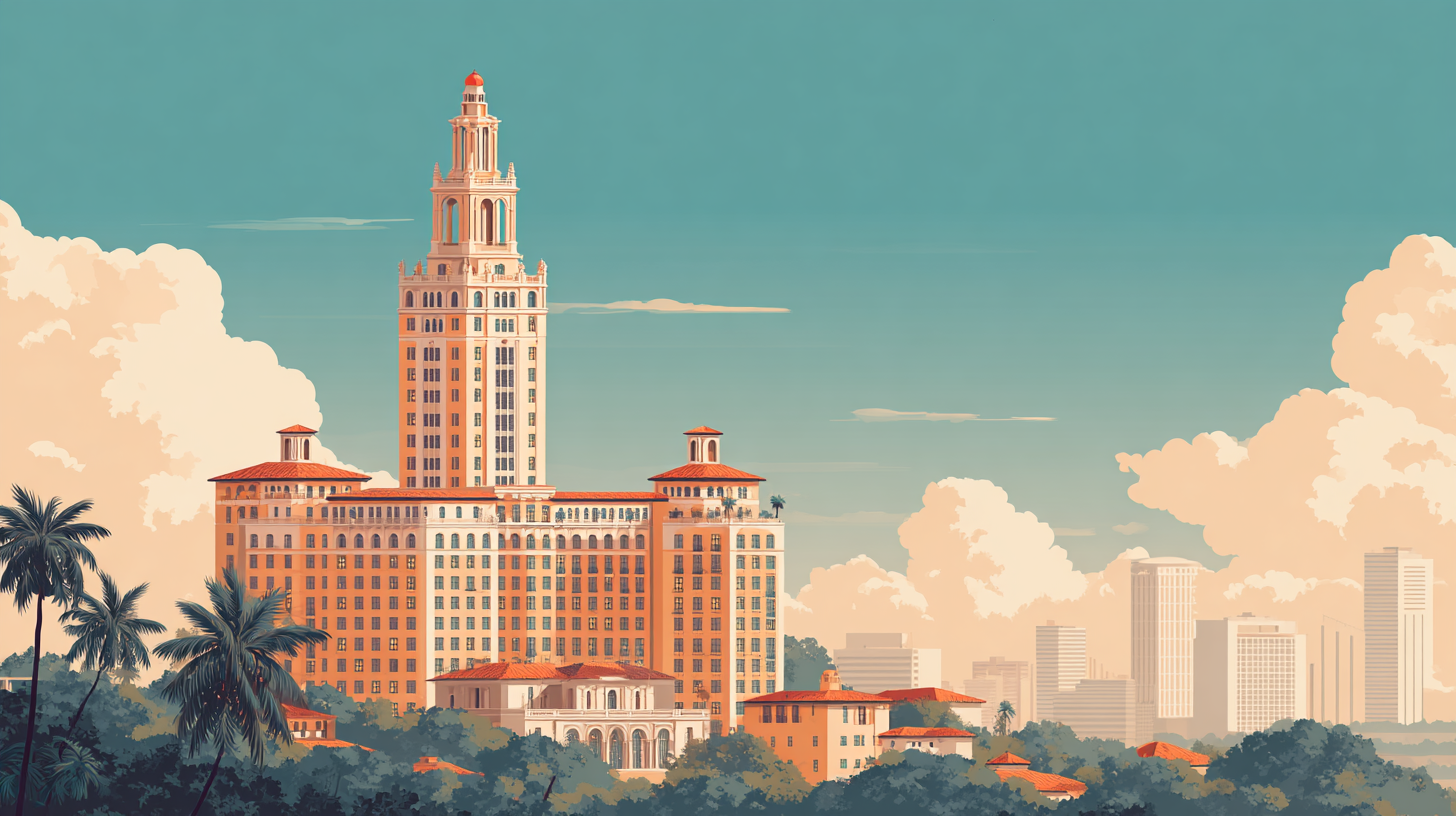
To be clear, this was not because I was unusually contemplative, although I’m sure I would have described myself that way at the time, likely while wearing something linen and pretending to understand architecture. It was because, from campus, you could see the spire of the Biltmore Hotel rising over Coral Gables like some kind of Mediterranean monolith. It was always there, regal, strange, yellow, cinematic, a little haunted, a little glamorous, the kind of building that seemed to contain a thousand better stories than whatever I was trying to come up with in my creative writing class.
The Biltmore was not part of the University of Miami, but it always felt like it should have been. It sat close enough to feel connected, but far enough away to feel aspirational. It was a castle on the horizon. A reminder that Miami was not just a place where people went to school. It was a place people came to experience something.
And I remember thinking, even then, wouldn’t it be incredible if the University of Miami had a school built around that?
Not just a hospitality program tucked into a business school brochure somewhere. I mean a real school. A serious school. A Miami version of Cornell’s School of Hotel Administration, which has spent more than a century turning hospitality into a field of rigorous business education. But this one would be grounded in the obvious, almost ridiculous advantage of being in Miami, one of the greatest tourism cities in the world.
Imagine it.
The University of Miami School of Hospitality, housed in and around the Biltmore. The hotel still operates as a hotel, perhaps under the auspices of a high-end hotelier such as Four Seasons, Aman, or another world-class hospitality brand. Guests still check in. Weddings still happen. People still order drinks by the pool and pretend they are not checking email. But woven into the life of the hotel is a working educational ecosystem.
Students learn finance, operations, real estate, branding, customer experience, food and beverage management, event design, luxury service, architecture, sustainability, and technology. Then they walk across the hall and see all of it happening in real time. They study revenue management in the morning and watch room pricing decisions play out in the afternoon. They learn restaurant operations and then spend time inside an actual kitchen. They study guest psychology and then observe what happens when a tired family arrives early, a bride panics over flowers, or a CEO wants something impossible in 12 minutes.
That is not theoretical education. This is pure boots-on-the-ground, real-world experience.
And what better place to do it than Miami?

Miami is not simply a city with tourism. Miami is tourism. It is hospitality, spectacle, culture, heat, food, design, nightlife, art, architecture, water, boats, cruise ships, conventions, beaches, sports, and people arriving from everywhere with wildly different expectations of what paradise is supposed to look like. In 2024, Miami-Dade attracted more than 28 million visitors. Those visitors spent roughly $22 billion and supported more than 209,000 tourism-related jobs.
Globally, travel and tourism are even more staggering. In 2025, the sector contributed about $11.6 trillion to global GDP and supported 366 million jobs. In the United States alone, travel supported 15 million workers in 2025. Leisure and hospitality payroll employment was nearly 17 million in April 2026. These are not quaint numbers from a pre-digital economy. These are massive, modern, growing numbers. Hospitality is not some charming analog leftover. It is one of the largest human systems on earth.
Which inevitably brings me to AI.
We are living through a strange moment where nearly every industry is asking some version of the same question: what happens when machines can do more of what we used to think only people could do?
AI can write the memo. AI can summarize the call. AI can generate the image, build the spreadsheet, analyze the data, make the itinerary, draft the pitch, compose the email, and, occasionally, hallucinate with the confidence of a junior associate who went to Duke. It is extraordinary. It is terrifying. It is useful. It is annoying. It is all of those things at once.
But the rise of AI also clarifies something we should have understood all along: not everything valuable is informational.
Some things are relational.
A hotel is not just a building with beds. A restaurant is not just a place that transfers calories from the kitchen to the table. A great bar is not just a commercial exchange involving gin. These places matter because of how they make us feel. They are stages for human experience. They are where anniversaries happen, deals happen, apologies happen, proposals happen, breakdowns happen, reunions happen, and occasionally, someone at the next table loudly explains cryptocurrency to a woman who has already emotionally left the conversation.
AI can optimize parts of hospitality. It absolutely should. It can help with booking, personalization, staffing forecasts, menu planning, maintenance, language translation, guest preferences, food waste, energy use, and a thousand invisible operational details that make a hotel or restaurant work better. AI will become part of the plumbing of hospitality, just as software became part of the plumbing of every other business.
But AI cannot be hospitable.

It can simulate warmth. It can remember that you prefer a high floor, extra towels, and oat milk. It can write a very convincing welcome note. But it cannot read the room the way a great host can. It cannot sense the barely perceptible shift in a guest’s face when something has gone wrong, but they are too polite to say it. It cannot decide, in a flash of human judgment, that the right thing to do is not the efficient thing, but the gracious thing. .
That is why I loved Will Guidara’s Unreasonable Hospitality so much.
On the surface, it is a book about restaurants, specifically about how Guidara helped turn Eleven Madison Park from a struggling two-star brasserie into the best restaurant in the world. But the book is really about attention. It is about the discipline of noticing people. It is about the radical idea that excellence is not just what you deliver, but how you make someone feel while delivering it.
What struck me most about the book was how little of it felt limited to restaurants. Yes, the stories are often about dining rooms, service teams, and improbable gestures. But the lesson applies everywhere. Advertising. Technology. Education. Medicine. Government. Parenting. Leadership. The best organizations do not merely complete tasks. They create moments of care.
That is the opportunity hiding inside the AI panic.
For years, we have rewarded efficiency so much that we have come to confuse it with value. We made everything faster, smoother, cheaper, more automated, and more scalable. And in many ways, that has been wonderful. I do not want to go back to a world where booking a flight requires a phone call, a fax machine, and a minor blood sacrifice. But somewhere along the way, we also trained ourselves to accept experiences that are frictionless but empty.
AI will make that temptation even stronger. The companies that see people as tickets, users, accounts, or conversion events will use AI to make those systems colder and faster. They will automate away the last remaining traces of personality and then wonder why nobody loves them.
But the great hospitality companies and the great schools that train people for that world can go the other way.
They can teach that technology is not the enemy of humanity. Indifference is.
A world-class hospitality school in Miami could become a living laboratory for that idea. It could teach students how to use AI without surrendering judgment to it. How to use data without reducing people to it. How to automate the invisible so that human beings have more time for the unforgettable. How to run profitable, sophisticated, technologically advanced businesses that still understand the emotional weight of a perfectly timed gesture.
That last part matters. Hospitality is not just niceness. It is not smiling until your face hurts while someone complains about the firmness of a pillow. Hospitality is strategy. It is culture. It is operations. It is taste. It is restraint. It is anticipation. It is the ability to make complexity feel effortless to the person on the receiving end.
That is an incredibly difficult skill set. And in the age of AI, it may become one of the most valuable skill sets we have.
Because the more artificial intelligence surrounds us, the more meaningful genuine human intelligence becomes.
I keep thinking about that Biltmore spire. When I was a student, I saw it as a beautiful old hotel in the distance. Now I see it as a metaphor. A building that has survived nearly a century of reinvention. A place that has been glamorous, strange, useful, neglected, restored, and beloved. A reminder that hospitality is not static. It changes with the world. It absorbs technology, fashion, economics, crisis, migration, culture, and taste. But at its center, it remains stubbornly human.
People will still travel because they want to feel something. They will still gather around tables because conversation is better when there is food between you. They will still remember the person who made them feel welcome when they were tired, nervous, grieving, celebrating, or far from home. They will still seek places that do not merely process them, but receive them.
So yes, AI is coming for a lot. It will reshape work, education, creativity, and commerce in ways we still do not fully understand. But maybe one of the smartest responses is not to fight it by trying to out-machine the machines.

Maybe the smarter response is to become more human than ever.
And hospitality, true hospitality, unreasonable hospitality, may be one of the best places to start. Not because it rejects technology, but because it gives technology a proper role. Let the machines handle the systems. Let them improve the logistics. Let them make the trains run on time, the rooms ready, the reservations smarter, the back office faster.
Then let human beings do what human beings still do best.
Welcome people. Notice them. Feed them. Remember them. Surprise them. Care for them.
If AI is going to force every industry to ask what people are still for, hospitality already has the answer.