
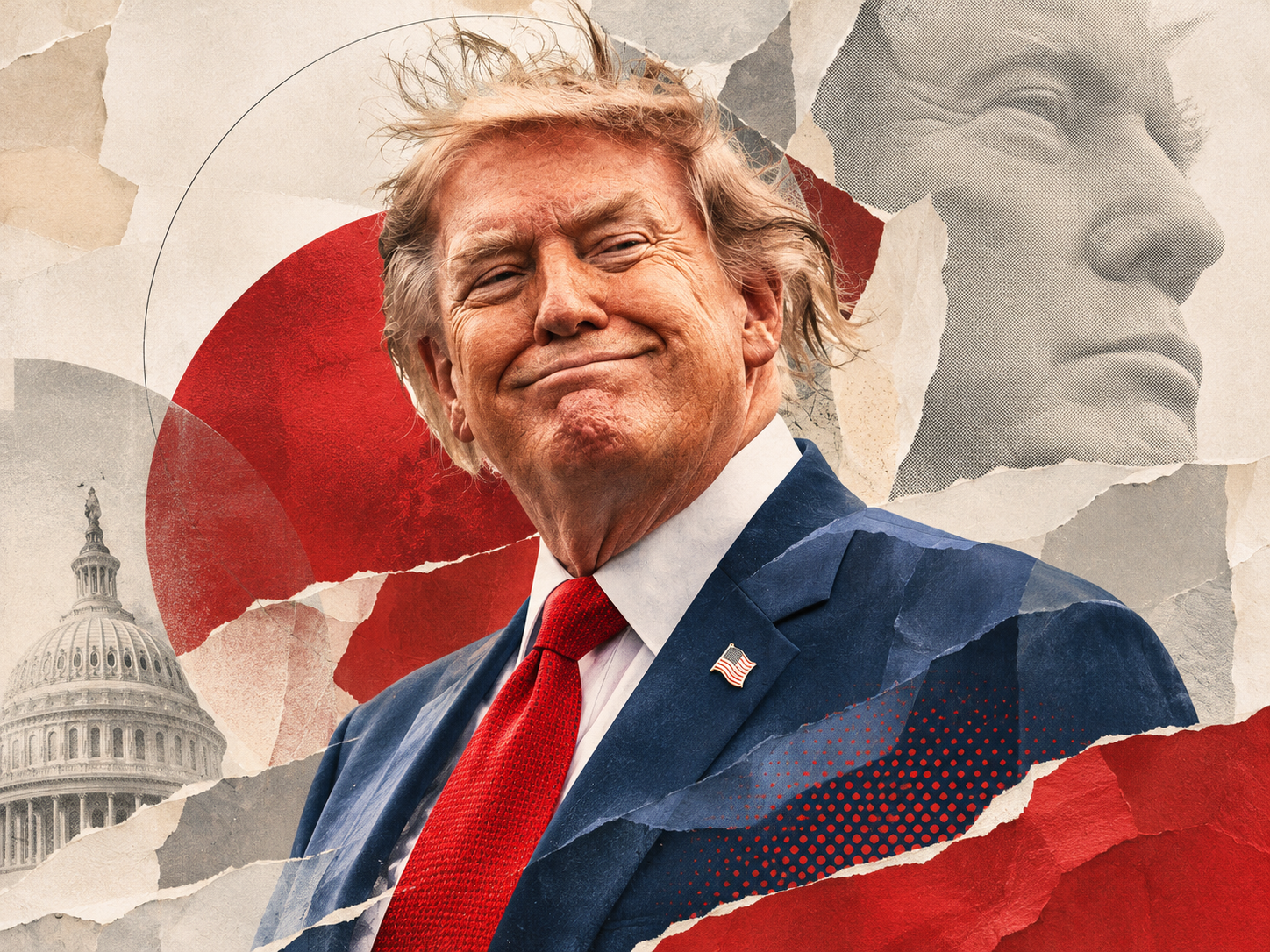
Why the new Democratic Congress should resist the temptation to make Donald Trump its next great political project.
There is a certain temptation that comes with finally getting the upper hand over someone who has spent years making your life miserable. You want to settle the score. You want to make them answer for everything they've done. You want them to experience, even briefly, the humiliation and helplessness they've inflicted on everyone else. I often thought about the revenge I’d enact on the kids who bullied me in middle and high schools. But I also realized the gratification of taking the high road.
But, after nearly a decade of Donald Trump dominating American political life, I fully understand how those of us on the left want retaliation against a vile man who has taken so much for himself while leaving a rotting corpse of democracy in his wake. Yet, in the aftermath of Tuesday's extraordinary midterm elections, as Democrats prepare to take control of both houses of Congress, I find myself arriving at a conclusion that might surprise some of my fellow Trump critics.
Don't impeach Donald Trump.
Not because he deserves protection. Not because accountability is unimportant. And certainly not because the serious questions surrounding his administration should somehow be forgotten. No, we should not impeach Trump because the American people have just handed Democrats something considerably more useful than another opportunity to put Donald Trump on trial. The American people have handed democrats the long time coming opportunity to govern. And I worry that, in their understandable enthusiasm to hold Trump accountable, Democrats might squander that power.
The Difference Between Getting Even and Getting Something Done
The scale of Tuesday's Democratic victory was remarkable. According to CBS News' election-night exit polling, Trump's approval rating among voters stood at approximately 38%. Roughly three-quarters of voters were dissatisfied with the country's direction while about nine in ten considered government corruption a major factor in their vote. Meanwhile, an Associated Press voter survey found that approximately seven in ten voters believed Congress wasn't doing enough to check presidential power. Sure, those numbers make an excellent case for oversight and accountability, but they don't necessarily constitute a mandate for impeachment.
Let’s look at what’s really bothering Americans: prices, economic security, healthcare, immigration, and a deeply unpopular war with Iran. And, truth be told, neither political party emerged from this election universally admired. Democrats benefited from widespread dissatisfaction with Republican governance, but that doesn't mean voters have offered them unconditional faith that they’ll do the right thing.
If Democrats spend the next two years consumed by impeachment proceedings, investigations designed for television audiences, and a seemingly endless search for the next political scalp, they risk confusing their electoral victory with an invitation to settle old scores. And from my end, I don't want Democrats to ignore the past, but I certainly don't want them to spend the next two years living in it. It should not be about getting even. It should be about getting something done.
We've Seen This Movie Before
We’ve impeached Trump twice. And the Senate acquitted him. Twice. During his second impeachment trial, in February 2021, 57 senators voted to convict. That was a bipartisan majority, but it fell short of the two-thirds threshold required by the Constitution. The calculations don’t change simply because Democrats have won control of Congress. Sure, the House can impeach a president with a simple majority, but removal requires the votes of two-thirds of senators present. And even with Democratic control, that would require substantial Republican support which I’m almost certain would never happen. (Unless we find Republicans finally scrambling to redefine their goals away from the orange stain in the Oval Office.)
There may be evidence that could eventually justify pursuing the difficult outcome of impeachment, but impeachment isn't supposed to be convenient, and constitutional accountability shouldn't depend entirely on political calculations. But it would be irresponsible to pretend that another impeachment automatically means another removal.
Quite frankly, I don’t think the country - in it’s fragile balance - could handle another impeachment. We don’t want months of hearings, competing legal interpretations, endless partisan accusations, and wall-to-wall cable-news coverage. Ultimately, it would be another chapter in the longest-running political reality show in American history.
And at the end of it, with Trump remaining exactly where he started. Personally, I'm not convinced that outcome would satisfy the people who voted for change on Tuesday.
And yes, there's a legitimate argument that impeachment serves purposes beyond removal: it establishes a record, exposes misconduct, and demonstrates that presidential power has limits. Those are serious and I’d never dismiss them. But impeachment is not Congress's only constitutional instrument, and it may not be the instrument best suited to every problem.
Congress Has Other Weapons.
For years, Americans have watched Congress surrender substantial practical influence to an increasingly powerful executive branch. Speaker Mike Johnson’s relationship with Trump was characterized by public loyalty and a willingness to advance much of the president's legislative agenda. Whatever one thinks of his motives, Congress repeatedly found itself defending presidential decisions rather than forcefully asserting its own institutional authority.
One need only to consider the tariffs. In February 2026, the Supreme Court ruled 6–3 that Trump had exceeded his authority by using the International Emergency Economic Powers Act to impose sweeping tariffs. It was a significant rebuke, although the administration continued pursuing tariffs under other statutory authorities.
Then, of course, there’s federal spending. In September, the Government Accountability Office concluded that the administration could not legally withhold congressionally appropriated funds past their expiration date under its proposed rescission maneuver. These aren't merely arguments about public policy. They concern the constitutional separation of powers.
The House and Senate control federal appropriations. Congress possesses the power to legislate on taxation and trade. Congress has authority over declarations of war and can shape military operations through legislation, oversight, and funding.
Trump is certainly powerful, but he isn’t all-powerful.
Mike Johnson has now reportedly decided not to seek the House Republican leadership position in the next Congress. His departure from leadership follows this devastating election for his party. I don’t lay blame squarely at Johnson’s feet, though he has been an enabler.
What I like to imagine, and perhaps it’s a naive thought, but what would happen if Congress began consistently exercising the powers it already possesses? Imagine an incoming majority that immediately turns its attention toward lowering household costs, strengthening healthcare, addressing housing affordability, reforming immigration enforcement, and demanding a credible plan for ending American involvement in Iran.
Pass legislation. Conduct oversight. Demand documents. Call witnesses. Use appropriations responsibly. Put bills on the president's desk and require him to respond.
Yes, Trump can veto legislation. Yes, overcoming a veto requires two-thirds support in both chambers, and most Senate legislation faces additional procedural hurdles. The reality is that even with a majority, the democrats cannot simply govern as though the president doesn't exist.
The public deserves to see which proposals can attract bipartisan support, which cannot, and where responsibility for legislative failure actually lies.
The measure of congressional effectiveness should not be how often members condemn the president, but what they accomplish for the people they represent.
Start With the Things Americans Can Actually Feel
Consider tariffs. In August, Reuters reported that approximately $100 billion in duties and interest had been processed for refunds following the Supreme Court's decision. My god is that an extraordinary amount of money. But those refunds generally go to importers that paid the tariffs, and not automatically to the consumers who may have faced higher prices. So what about those consumers? What about the small businesses that absorbed those costs, or delayed hiring, or adjusted prices because of trade uncertainty?
What Congress should do is examine whether additional economic relief, tax measures, or carefully designed compensation programs are warranted and legally feasible.
Then there's immigration enforcement. According to a June 2026 GAO report, the average daily number of people held in ICE detention rose from 39,314 in January 2025 to 67,204 in April 2026, an increase of approximately 71%. Congress has already committed enormous sums to immigration enforcement, including roughly $75 billion in multiyear ICE funding through fiscal year 2029. Forget about “immigrants taking our jobs” and be more concerned with “ICE stealing your wallet.”
Congress can and should investigate detention conditions, examine enforcement practices, propose new statutory limits, reconsider existing funding commitments, and demand compliance with constitutional protections. While I recognize that immigration enforcement is a legitimate government function, so too is ensuring that the government exercises that function lawfully, humanely, and with meaningful accountability.
And, of course, let’s not forget about the debacle of Iran. By mid-October, Pentagon estimates reported by the Associated Press placed the cost of the war at approximately $47.1 billion. Forty-seven billion dollars. And that figure that does not adequately convey the human consequences of the conflict, the American service members killed or wounded, or the suffering experienced across the region.
Trump and his stooge, Pete Hegseth, may argue military action has served critical national-security objectives, particularly preventing Iran from obtaining a nuclear weapon. But what we as Americans should question are the war's authorization, proportionality, duration, and strategic consequences. Lawmakers can demand a coherent military and diplomatic strategy, debate authorizations for force, scrutinize defense spending, and examine opportunities for a negotiated resolution.
I fully understand that these are substantial tasks. None of them requires making a third Trump impeachment the centerpiece of congressional life.
Accountability Doesn't Have to Begin at the Top
All of that said, I don’t think congressional investigations should stop. In fact, I’d like them to increase. I would like to see serious, sustained, evidence-driven oversight throughout the executive branch. Let’s start with the decisions. Follow the money. Follow the communications. Establish who authorized what, who knew what, and whether laws were followed.
Consider Defense Secretary … sorry, “Secretary of War,” Pete Hegseth. In April, House Democrats introduced six articles of impeachment involving allegations about the Iran war, military decision-making, sensitive information, and congressional oversight. Those are allegations, not judicial findings. And who would have thunk that Hegseth’s Pentagon would reject the effort as “political theater.”
But the underlying issues deserve factual examination. If Congress determines that credible evidence supports impeachment of a Cabinet official, that question should be considered on its own constitutional merits. The same principle applies to immigration leadership, including the decisions made during Kristi Noem's tenure at Homeland Security before her dismissal in March. Oh, and it certainly applies to DOGE.
An August 2026 GAO investigation identified 206 DOGE personnel who had served in the Executive Office of the President during the period reviewed. Auditors could not verify all personnel's compliance with ethics and financial-disclosure requirements because the administration and several agencies had not supplied sufficient records. Another GAO investigation identified DOGE access to more than 23 information systems at four agencies, while finding substantial gaps in documentation about access and security controls.
These findings don't establish that every DOGE employee committed misconduct, but they do establish legitimate questions for Congress to investigate. Let’s find out who had access to sensitive information, who approved that access, what safeguards existed, and whether public funds and federal data were handled properly?
Similarly, the Epstein Files deserve continued scrutiny. Trump already signed the Epstein Files Transparency Act in November 2025, and the Justice Department says it has released nearly 3.5 million pages. The relevant issue now is whether the government has fully complied with the law, including lawful redactions and the protection of victims. The Justice Department's inspector general opened an audit into that compliance in April.
But let’s make sure that follows evidence rather than conspiracy theories or predetermined conclusions. After all, there is a difference between investigating government misconduct and announcing in advance what or whom the investigation is out to destroy.
The Republican Party Has Its Own Reckoning Ahead
Perhaps the most fascinating political phenomenon of the next two years will be watching Republicans attempt to navigate their relationship with Donald Trump. For years, loyalty to Trump became a defining element of Republican politics. Candidates sought his endorsement. Officeholders defended his decisions. Party leaders learned that publicly disagreeing with him could bring immediate political consequences. But the day of reckoning is upon us.
How do you establish an identity independent of Trump without alienating voters who remain deeply committed to him? And how do you defend the policies and decisions of his presidency while also responding to voters who expressed dissatisfaction with those decisions?
We can already see that tension playing out on cable news. On November 4, Reuters reported that Vice President JD Vance was publicly questioning the Iran war's value and connecting it to Republican electoral losses. Trump also acknowledged that the war contributed to those losses while defending his decision to pursue it. Those disagreements raise questions that extend well beyond any one election.
What parts of the MAGA agenda will Republicans continue to embrace? Which will they reconsider? How will they reconcile the demands of their most committed primary voters with the concerns of a broader electorate?
I don’t know the answers, but the Republican Party built its political identity around one man, and it now has to confront the complications and downfalls of that decision.
They built this shit house themselves. Now they have to live in it.
Democrats don't and shouldn’t need to resolve that dilemma for them. And they definitely don't need to spend the next two years making Trump the central character in every congressional drama.
A Different Kind of Victory
Donald Trump is nearing the end of his final constitutionally permitted presidential term. (I can’t believe I have to add “constitutionally” to that sentence, but yet here we are.) That doesn't make him powerless. Like it or not, Trump still has significant constitutional authority until the day he leaves office. But what it does mean is that the nation has an opportunity to begin thinking beyond him. That, I find, is a beautiful thing.
For most of the past decade, American politics has revolved around Donald Trump. His declarations. His controversies. His enemies. His legal battles. His election campaigns. His hatred. His vileness.
But like the reality star he is, he has occupied an almost unimaginable amount of our collective attention. Another impeachment would place him back at the center of the national conversation yet again. There are circumstances in which that might be necessary. A new, grave abuse of constitutional authority or compelling evidence of impeachable wrongdoing could alter the calculus entirely. But there is no constitutional requirement that impeachment should be Congress's first response to an administration it opposes.
A Democratic Congress should instead devote substantial energy to reclaiming legislative authority, protecting constitutional rights, investigating genuine wrongdoing, and confronting the country's economic and foreign-policy challenges. That would not necessarily produce sweeping legislative victories. Divided government is difficult by design, and constructive compromise remains indispensable. But the work wshould be directed toward the future, rather than consumed by another attempt to relitigate the past.
And, at the end of it all, the possibility that most interests me isn't seeing Donald Trump defeated in another Senate trial. No, it's seeing an American Congress become something more consequential than a supporting character in Donald Trump's story.
An institution with its own responsibilities. Its own priorities. Its own constitutional identity. And, most importantly, an obligation to the American people that exists independently of whoever occupies the White House.
Like most Americans, I want accountability. I want answers. I want lawful consequences wherever the evidence warrants them.
But I also want affordable groceries. Affordable healthcare. Greater economic security. A foreign policy that places a meaningful value on human life. An immigration system that respects both the law and human dignity. And a Congress that remembers it was elected to do more than express outrage.
We don't have to choose between accountability and governing. But we cannot allow the pursuit of accountability to become an excuse for failing to govern.
The last thing this country needs is two more years in which every road leads back to Donald Trump.
He's had more than enough of our attention.
It's time Congress paid some attention to the rest of us.